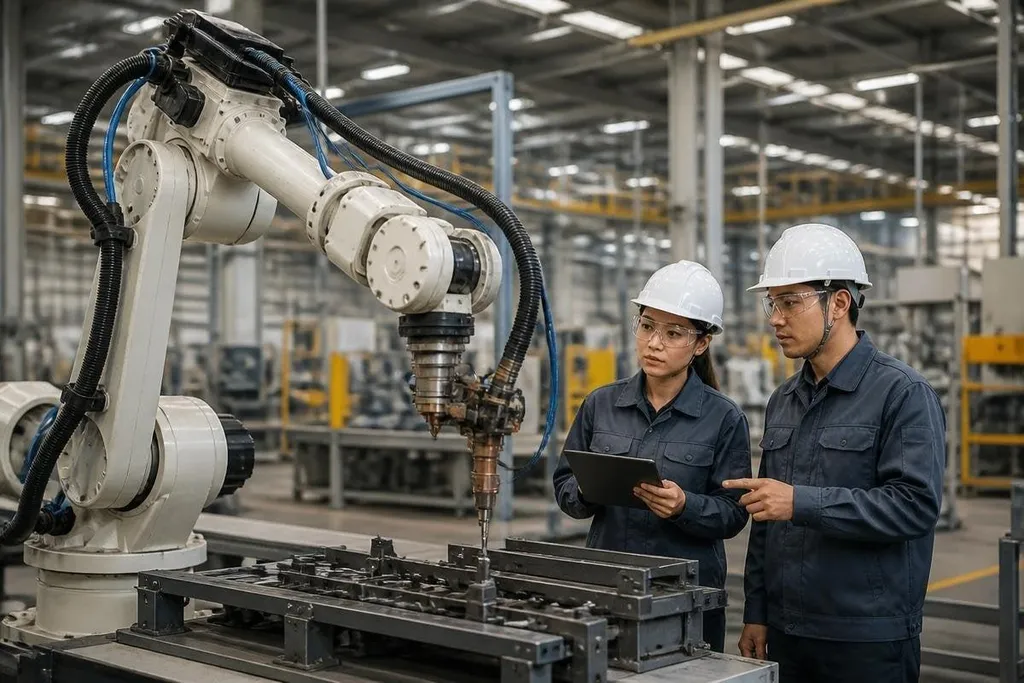
A robot can keep a welding line running after a shift ends, but that arm cannot build a factory on its own. Countries gain from automation when machines raise output, workers learn new tasks, and firms can afford the power, software, and repairs.
Quick read
- Robots can produce more goods with the same floor space.
- The gains depend on skills, electricity, local suppliers, and demand.
- Poorly planned automation can cut jobs without raising wider output.
Where robots can lift output
Factories use robot arms for fixed tasks such as welding, painting, palletizing, and machine tending. The arm follows a programmed path, while sensors check its position and a gripper holds the part.
This suits work that repeats often and exposes people to heat, fumes, or heavy loads.
A mobile robot changes the job in a different way. It can carry bins between storage, assembly, and packing areas, using LiDAR or cameras to map nearby objects. Workers then spend less time walking and more time handling parts, checking faults, or setting up the next run.
That extra output matters only when someone can buy the goods. A factory that makes more parts for a weak local market may cut prices or reduce shifts instead of hiring more people. Automation raises production capacity; demand decides how much of that capacity gets used.
The wider gains depend on local work
Robots need more than a purchase order. A site needs electricians, controls engineers, maintenance staff, safety checks, spare motors, software support, and a reliable power supply. If those services come from another country, much of the spending leaves the local economy.
The same problem appears in smaller firms. A large manufacturer may have staff who can set up a robot cell and connect it to a programmable logic controller. A small workshop may lack that support, so the machine sits unused after the first fault.
Training changes the result. A technician who can read a motor fault, replace a sensor, and adjust a robot's path can keep production moving. That person may have started as a machine operator, but the new job needs time, teaching, and a clear path to higher pay.
Training only raises output when the worker has a real system to run. Robot24.com can connect a robot claim to a named company, task, work site, and date. That keeps the growth case tied to machines in use, not a trade-show clip, before we look at what happens when those systems fail.
What can go wrong
Automation can move work rather than remove it. A robot may take over one task, then create jobs in maintenance, quality checks, logistics, and software. Those new jobs may appear in another city or require skills that displaced workers don't yet have.
Costs can also erase the expected gain. The machine needs integration, guarding, training, power, software updates, and spare parts. A company that counts only the robot's purchase price can make a poor decision before production even starts.
There is a second limit: robots still struggle with many changing tasks. A fixed arm can place the same part thousands of times, but a mixed pile of soft, damaged, or unfamiliar objects needs better sensing and control. Human workers remain useful when the job changes often or each order is different.
I think robots can help countries grow faster, but only when automation is paired with skills and local production support. Buying machines without that base creates equipment spending, not lasting growth.
A practical check before public support
A government or company weighing an automation project should ask:
- Name the task: Can the robot repeat one clear job often enough to justify setup?
- Count the full cost: Include guarding, software, training, power, repairs, and downtime.
- Plan the people: Set out who will run the cell, fix faults, and learn the next skill.
- Check local supply: Find nearby sources for parts, service, integration, and electrical work.
- Measure the result: Track output, defects, worker safety, energy use, and pay after deployment.
- Set a review date: Stop, change, or expand the project using measured results rather than the original promise.
That last check keeps automation tied to a real result. The useful question for any country is not how many robots it buys, but how much more its workers and firms can produce after the machines arrive.